
With the ever-growing pressure on environmental regulations and the desire to ensure the efficiency of operations becomes the priority, wastewater treatment and oil processing industries encounter the challenge of complex separation management more than ever. These industries need continuous, high-performance separation technologies that are used in the separation of oil, water, and fine particulates, as well as high-solid sludge. The use of decanter centrifuges in this regard has proved to be unavoidable, as it provides unmatched high efficiency, flexibility, and sustainability in harsh industrial settings.
Introduction to Decanter Centrifuges
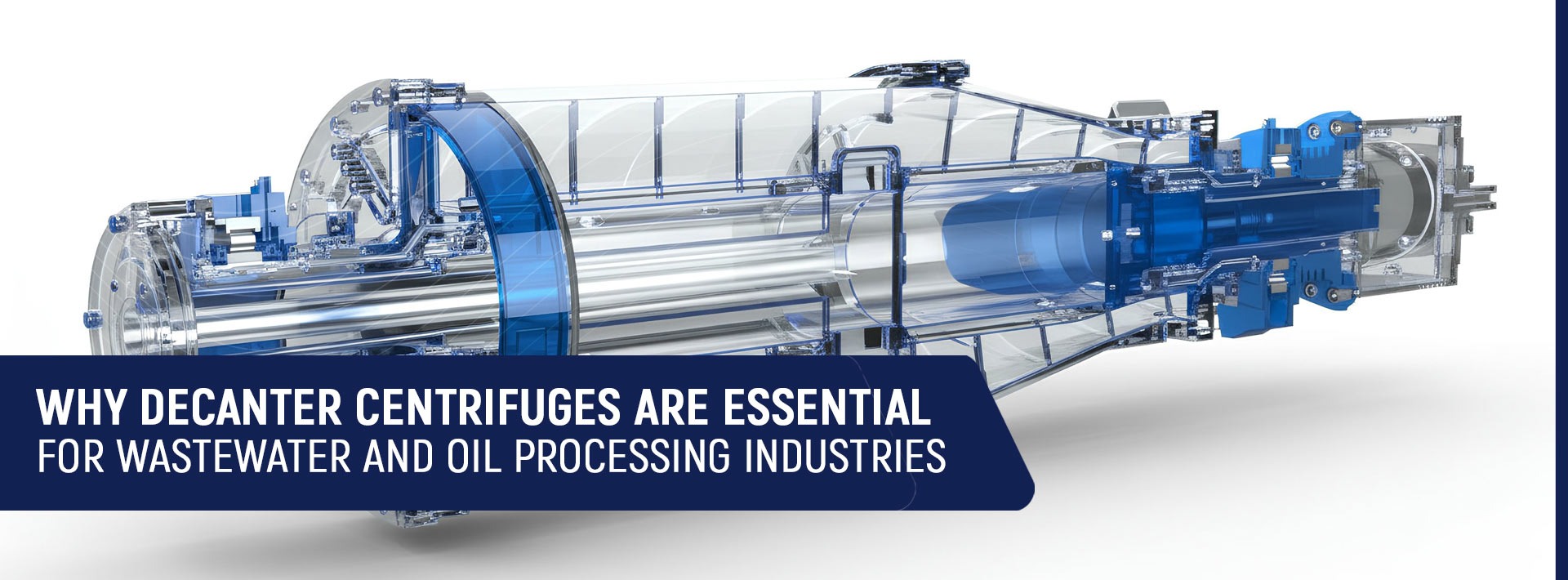
A decanter centrifuge is a device that employs centrifugal force, which causes the solids and the liquids, or liquids of different densities, to be separated with the help of centrifugal force. Continuously, it operates with a rotating bowl and a scroll conveyor that sweeps separate solids, and clear liquid flows out simultaneously. This constant, automatic design also makes the decanter centrifuges applicable in large-scale, high-throughput processes (as is characteristic of wastewater and oil processing facilities).
Use of Decanter Centrifuges in Removing Wastes in the Water
Efficient Sludge Dewatering
One of the most critical issues in wastewater treatment plants is the sludge management. The management of sludge and its disposal is usually a high cost to the overall business. Decanter centrifuges are effective in sludge thickening and dewatering of sludge to reduce the amount of water content in sludge and sludge volume.
The decanter centrifuges lessen the transportation, handling, and disposal expenses by producing drier solids. The efficiency comes in especially in the municipal and industrial wastewater treatment plants that are attempting to take advantage of operating budgets.
Unvarying and Reliable Process
Wastewater treatment is an activity that takes place 24/7, and interruption of processes can lead to noncompliance and environmental risks. Decanter centrifuge design shall be to run continuously and without attention to ensure that the centrifuges can be stable even when there is a change in feed conditions and solid concentrations.
They are extremely strong, thus able to handle abrasive and heterogeneous streams of sludge without regular maintenance, and they are highly dependable in the long term.
Sustainability and Environmental Conformity
As the environmental regulations become more stringent, the wastewater treatment plants are expected to achieve higher levels of efficiency with the reduction in the use of chemicals, as well as the reduction in the power input. Decanter centrifuges are one of the solutions to sustainable operations since they give the opportunity to recover the water effectively and reduce the application of chemical additions during the dewatering.
Less sludge content also means less use of landfill and reduced environmental impact, which ensures that plants respond to regulatory requirements and sustainability goals.
Centrifuge Decanter Impact on the Oil Processing Industry
The oil processing operation generates mixed complexes of oil, water, and solids when drilling, refining, and production take place. Decanter centrifuges have been very effective in the separation of these constituents that yield maximum oil recovery, giving cleaner water and manageable solid waste.
This is vital in ensuring that the product is maximized and losses are minimized in the process of undertaking the upstream, midstream, and downstream oil operations.
Drilling of Mud and Oily Sludge
The centrifuges that are also used frequently in the drilling mud process include decanter centrifuges, in which the fine solids are separated, and the useful drilling fluids are returned. This facilitates the reduction of the use of new materials, and the overall cost of operation is reduced.
Decanter centrifuges can be used in the case of refineries and oil terminals to clean up oily sludge, separate recoverable hydrocarbons, water, and solids. Not only does this help in improving the management of waste, but it also adds value to recoverable waste.
More Process Safety and Reliability
The oil processing environment is normally harsh and dangerous. The type of centrifuges used is the Decanter type, which is resistant to heat, corrosive, and hostile working conditions. Their design is closed such that the operators are not exposed to hazardous substances as much, thus increasing their safety in the workplace.
Notable benefits of Decanter centrifuges in the two industries
High Separation Efficiency
The centrifugal force generated by decanter centrifuges is extremely high, and thus, they are capable of separating fine and recalcitrant solids. This provides a constant performance even in varying characteristics of the feeds, as in the case of wastewater and oil processing.
Reduction of Costs and Shorter Payback
The decanter centrifuges cause the plants to save a substantial amount of money by minimizing losses on products, diminishing the wastes generated, and lowering the quantity of chemicals and energy consumed. They are also fully automated, and they require less labor as they operate at all times, thus the sooner they can be invested in.
Operational Flexibility
Decanter centrifuges can be easily modified to accommodate changes in feed flow, solid concentration, and process demands. It is suitable for an extremely wide variety of applications: municipal wastewater treatment facilities or heavy-duty oil processing facilities.
Making it easier with digital technology
The modern decanter centrifuges can be equipped with high-order control systems where the real-time observation and the opportunity of correct regulation of the working parameters are also facilitated. This enhances better control of the processes, less downtime, and a predictive method of maintenance.
Extended Service and Minimized Maintenance
Durability designed: This will guarantee a long life span of the decanter centrifuges and a low level of maintenance. It is done by means of wear-resistant and modular elements, which enable it to engage in reliable operations even in a corrosive environment and abrasiveness.
You may also like: Applications And Benefits Of Decanter Centrifuges In Turkish Process Industrial Plants
Conclusion
The potential to offer effective, uninterrupted, and accountable separation of wastewater and oil processing industries resulted in the decanter centrifuge becoming an inevitable piece of equipment. They address such burning issues as the decrease in sludge, oil recovery, the decrease in waste, and regulations that result in the improvement of efficiency and cost management.
The decanter centrifuges will continue to be one of the centerpieces of the industries that are increasingly becoming automated and eco-friendly around the globe to offer cleaner processes, safer operations, and economic viability in the long run. In the instance of the wastewater treatment plant, just like the oil processing plant, decanter centrifuge technology is not only a technical choice but a strategic choice.
FAQs
1. What is the purpose of a decanter centrifuge?
A decanter centrifuge is designed for continuous solid–liquid separation in industrial processes. It uses high centrifugal force to separate solids from slurry mixtures and is commonly used in wastewater treatment, food processing, oil & gas, and chemical industries.
2. What is the difference between a decanter centrifuge and a normal centrifuge?
A decanter centrifuge operates continuously and handles large industrial volumes, making it ideal for heavy-duty processing. A normal centrifuge typically works in batch mode and is used for smaller-scale or laboratory applications.
3. What are the benefits of a decanter?
Decanters provide high separation efficiency, continuous operation, automation, reduced manual labor, and lower long-term operating costs. They are also effective for handling high solid concentrations.
4. What are the different types of decanter centrifuges?
Common types include two-phase decanters (solid-liquid separation), three-phase decanters (solid and two liquids), and tricanter systems for advanced separation needs.
5. What is a decanter in the oil and gas industry?
In oil and gas operations, a decanter centrifuge separates drilling mud, oil, water, and solids, helping recover valuable fluids and reduce environmental waste.
6. What does a centrifuge do in wastewater treatment?
In wastewater plants, a centrifuge separates sludge solids from treated water, reducing sludge volume and lowering disposal costs while improving plant efficiency.